

BLUFF CITY PROJECTS
Bluff City Construction, LLC (BCC) Environmental Remediation Division, is among the most experienced and financially secure regional environmental construction firms in the Midwest. Backed by the extensive material and financial resources of Bluff City Materials, Inc. and its parent, Southwind Industries, Inc. (SI), BCC can execute major environmental, civil and geotechnical projects. BCC’s current bonding capacity is $10 Million per project with a $30 million aggregate with additional capacity available. Our financial surety is provided by Liberty Mutual, CNA and Western Surety. In addition to standard industry coverages in our General Liability Insurance, BCC carries a $25 Million Umbrella Policy. SI’s assets include over $200 million in construction equipment (average equipment age is 3 years) and over 6,000 acres of property available for commercial and industrial development. In addition, SI and its subsidiary companies have over 100 years of sand, gravel and limestone reserves.
FINANCIAL STABILITY
BLUFF CITY PROJECTS

GEOPOOL® DEWATERING SYSTEM
Bluff City Construction, LLC (BCC) is the exclusive distributor of the patented GeoPool® Dewatering System technology across eleven states: Iowa, Indiana, Illinois, Kentucky, Michigan, Minnesota, Missouri, New York, Ohio, Pennsylvania, and Wisconsin.

PETROLEUM REMEDIATION & WETLAND RESTORATION
Bluff City Construction, LLC, through its environmental division. Abbott Constructors, Inc., was contracted by Lane Construction, Inc. to remediate a 2.5-acre wetland that is contaminated.

ASH CITY POND #2 CLOSURE
NRG JOLIET GENERATING STATION
BCM Construction, LLC (BCC) was engaged by NRG Energy, Inc. (NRG) to execute a clean closure of a Coal Combustion Residuals (CCR) pond at their Joliet Power Generation Station...

Stormwater Basin Construction
At the former Edwards Generating Station, BCC constructed a new stormwater basin to reroute water from the soon to be capped coal ash pond. This project included erosion and sediment control, surveying, and excavation for the basin, along with installation of a pretreatment basin designed to capture sediment and debris before stormwater enters the main basin and associated gate valves.

NRG POWERTON ASH BYPASS BASIN RETROFIT
The Ash Bypass Basin at the Powerton Generating Station is a legacy coal combustion residual (CCR) surface impoundment previously used as a settling pond for bottom ash, transport water, and other plant process wastewater. The Bypass Basin had been inactive since October 2020, when cleanout operations began.

BENEFICIAL COAL REUSE
BCC remediated a closed power plant by reclaiming 50,000 tons of coal for beneficial reuse. Following the coal analysis for quality control the material was excavated, staged, and transported to a Midwest co-generation facility, turning a legacy waste into a clean energy resource.

CITY OF CHICAGO – SOIL & DEBRIS MANAGEMENT CONTRACT
In 2010, The City of Chicago, awarded Bluff City Construction, LLC (Bluff City) a prime contract to manage soils and debris derived from capital infrastructure programs managed by the city.

HANSEN MINE RESTORATION
Bluff City Construction, LLC, was awarded a 5 year contract by Lehigh Hansen Cement, Inc. to restore its Hansen Materials mine in Romeoville, Illinois. This project involves significant materials management, .

IMPACTED SEDIMENT DREDGING, NRG WAUKEGAN GENERATING STATION
BCM Construction, LLC (BCC) was engaged by NRG Energy, Inc. (NRG) to remove potentially impacted sediments from the stations Lakeside Cooling System Outlet and Cooling Intake Canal, 50,000 cubic yards of sediment were dredged from the Lakeside Cooling System Outlet and 15,000 cubic yards of sediment were dredged from the Cooling Intake Canal.

USS LEAD SUPERFUND SITE SOIL REMEDIATION
BCC was hired to provide remediation services at the USS Lead Superfund site, which included parts of the former USS Lead facility and surrounding commercial, municipal, and residential areas. The primary contaminants of concern at this site were lead and arsenic. The USS Lead site was listed on the National Priorities List of the worst contaminated sites in the country in 2009.

INDIANA HARBOR DISPOSAL FACILITY DIKE EXPANSION
Prior to the construction of the Indiana Canal Confined Disposal Facility (CDF), the site operated as a petroleum refinery and storage facility, commonly referred to as the ECI (Energy Cooperative Industries) site. To prevent contaminant migration off-site, a slurry wall and groundwater gradient control system were installed before CDF construction began around 2010.

NEW PORTE LANDING DEVELOPMENT PHASE 2A
Bluff City Construction, LLC and Integrated Environmental Solutions, Inc. Team was awarded a contract for remediation of the City of LaPorte, Indiana New Porte Landing Development .

LaSalle Canal MGP
Sediment Remediation Site
Bluff City Construction, LLC (BCC), D Construction (D) and White Lake Dock and Dredge, Inc. (WLDD) are currently executing the largest In-Situ Stabilization of MGP Impacted Sediments...

Edwards Generating Station Coal Reclamation
BCC evaluated and performed analysis on the coal prior to excavating and reclaiming 118,000 tons of usable coal from former Edwards Generating Station. The coal was staged, loaded, and transported for reuse as fuel at a Midwest co-generation facility. By transforming an idle resource into a source of energy, this effort not only supports environmental cleanup but also advances resource recovery and sustainable power generation.
LONGMEADOW PARWAY SOIL REMEDIATION
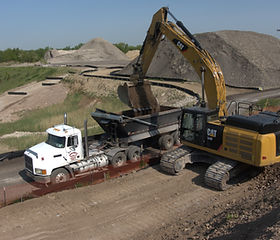
In the engineering and surveying for this project, large volumes of contaminated soils impacted by lead and semi-volatile organic compounds were found. The site was then enrolled in the Illinois EPA Site Remediation Program (SRP). BCC was contracted to remediate the site so that final construction of the highway could continue.

WEST CHICAGO IMPACTED SOIL REMOVAL
Past industrial activities at the site resulted in shallow soil impacts from metals and semi-volatile organic compounds. Subsurface studies have defined the extent of these impacts, showing contaminant levels that, while not classified as hazardous, exceed the Illinois Environmental Protection Agency’s soil remediation objectives.